
The Mississippi Farm Bureau Federation worked diligently to protect the private property rights of Mississippians during the 2022 Legislative Session by supporting legislation that would uphold Initiative 31, the ballot-measured initiative championed by Farm Bureau in 2011. The constitutional amendment prevented the government from using eminent domain to take private land for the use of other private entities.
In April, Gov. Tate Reeves signed House Bill 1769 into law, which codified the eminent domain constitutional amendment into general law.
“After initial surprises at the beginning of the 2022 Legislative Session, both the House and Senate realized the urgency and importance of codifying this issue,” MFBF President Mike McCormick says. “With only two weeks left in the session, both chambers suspended the rules and unanimously passed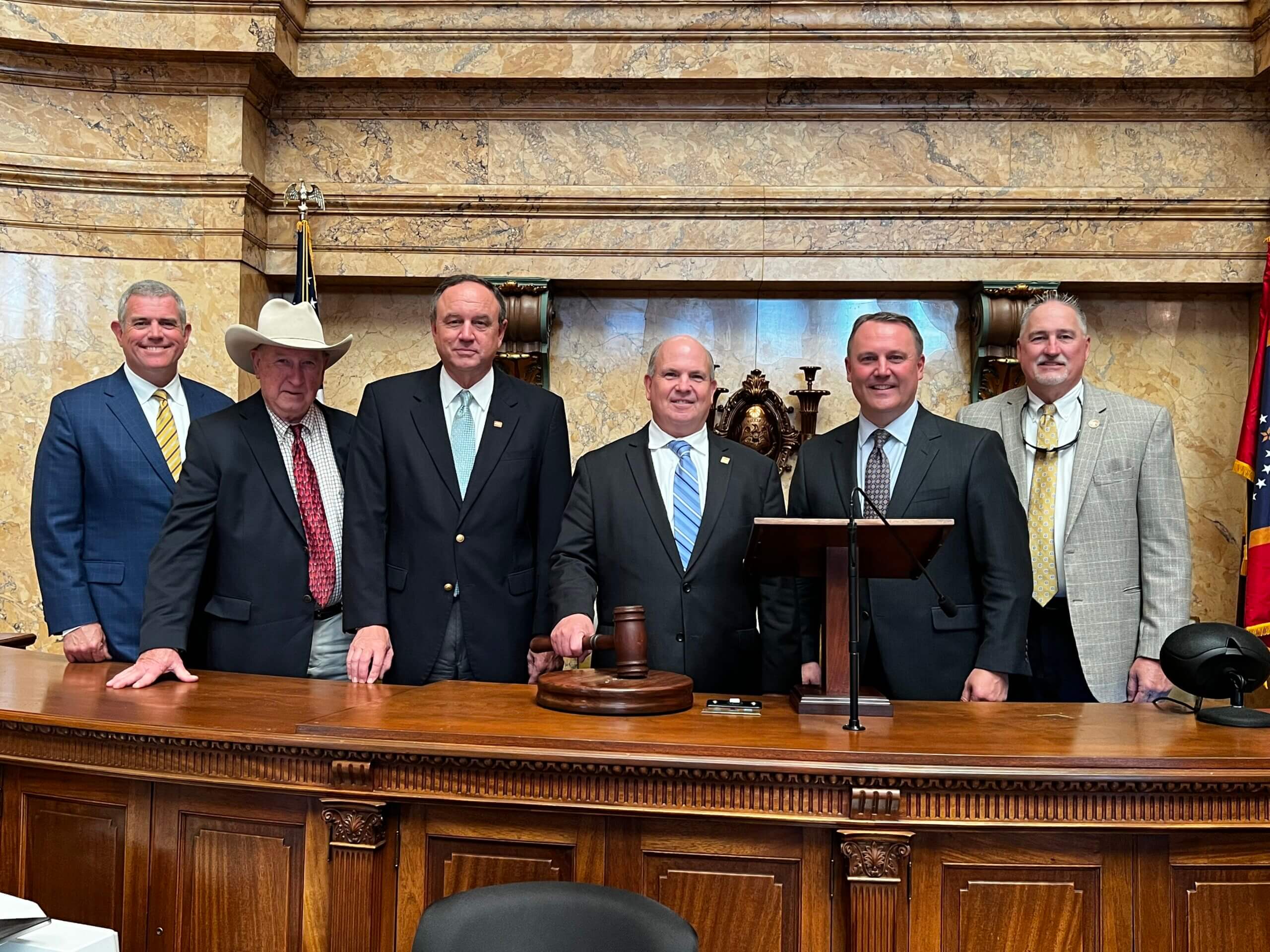 HB 1769, which codified the constitutional amendment word-for-word.”
In May 2021, the Mississippi Supreme Court overturned the medical marijuana initiative overwhelmingly approved by voters in November 2020. They did this due to a discrepancy in the initiative process. Initiative process language dictated that the number of registered voter signatures needed to place an issue on the ballot should be gathered equally from Mississippi’s five congressional districts as they existed in the 1990s. After the 2000 U.S. Census was released, Mississippi lost one of its five congressional districts. Because of this, the entire initiative process was ruled invalid.
Since the change in congressional districts, Mississippi voters have approved three initiatives – eminent domain, medical marijuana and a voter identification requirement. The Mississippi Legislature previously passed legislation to place the voter identification requirement into general law, which prevented it from being impacted by the 2021 Mississippi Supreme Court ruling.
Prior to beginning the 2022 Legislative Session, the Mississippi House and Senate prepared to address the medical marijuana and eminent domain ballot initiatives. In doing so, they immediately passed a medical marijuana law in January, upholding that initiative. Next, both chambers worked on legislation pertaining to the eminent domain initiative.
“Farm Bureau pushed to make sure legislation was passed to secure the eminent domain initiative in the Mississippi Constitution,” McCormick says. “We support a Mississippi law that would protect private property rights. We feel a U.S. Supreme Court decision that gives local governments the right to seize private property from owners using the ‘eminent domain’ principle for transfer to other private entities should be against state law.”
In the 2005 Kelo V. New London (CT) case, the U.S. Supreme Court ruled that private economic development qualified as a public use, giving local governments the authority to take private property and transfer it to other private entities unless state laws prevented it. Following this ruling, MFBF began pushing for legislation that would prevent this from happening in Mississippi. MFBF sponsored and led the two-year Initiative and Referendum Campaign that resulted in Initiative 31 passing during the November 2011 General Election.
“I am proud of the hard work our public policy team, staff and members put into successfully getting this legislation passed,” McCormick says. “Initiative 31 and all legislation pertaining to protecting the private property rights of Mississippians is the most important issue the Mississippi Farm Bureau Federation has ever worked on and supported.”