
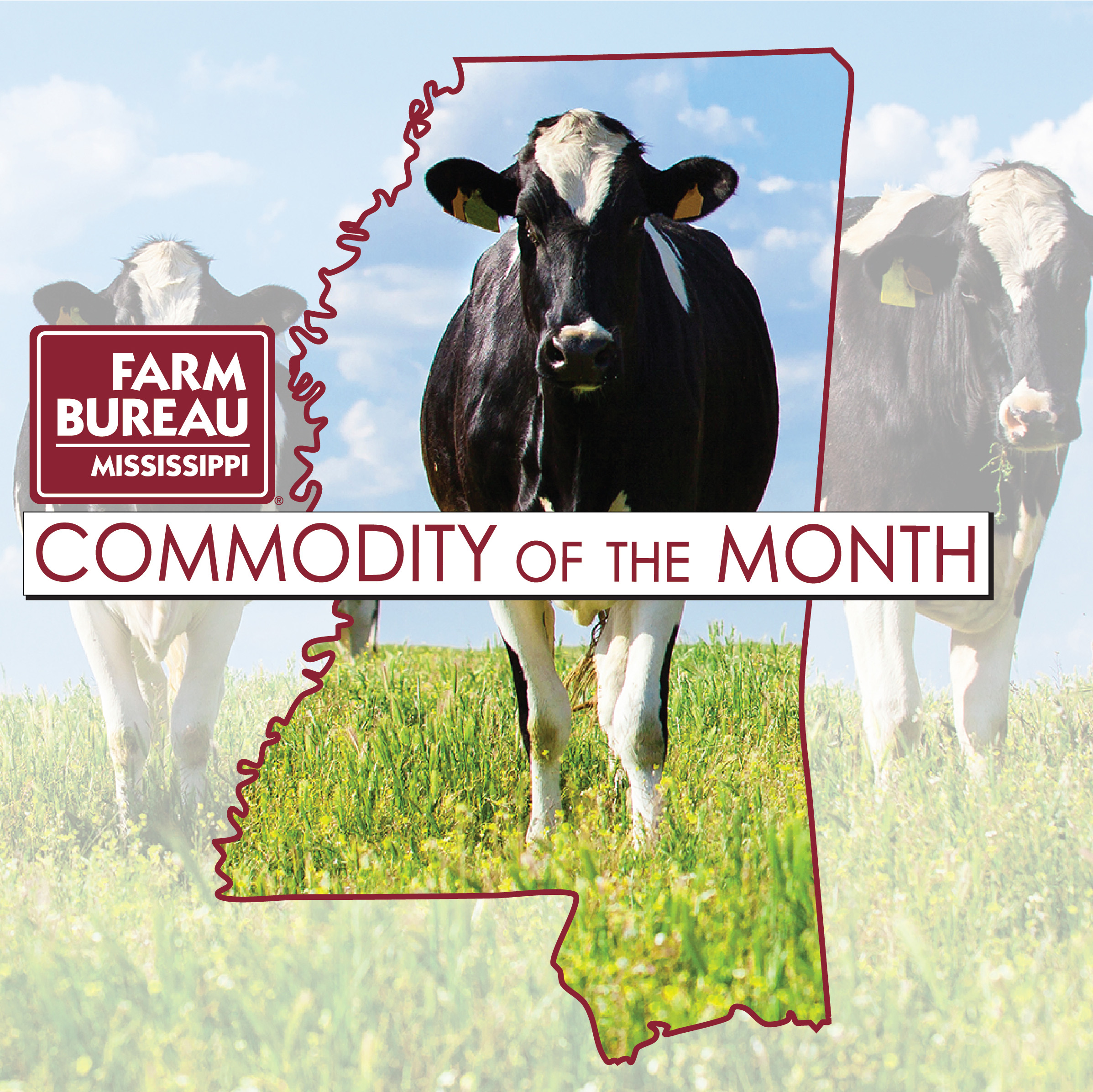
Since 1939, National Dairy Month has encouraged families to make milk their beverage of choice based on its nutritional value. In honor of this nationally recognized occasion, Mississippi Farm Bureau Federation proudly celebrates the enduring spirit and vital contributions of Mississippi’s dairy industry.
Mississippi is home to just over 40 dairy farms and about 6,000 dairy cows, which collectively produced nearly 9 million gallons of milk last year. In addition to enriching our diets with essential nutrients, this production also plays a crucial role in our state’s economy, generating $17 million in production for 2023.
According to the International Dairy Foods Association’s Dairy Delivers economic map, the United States’ dairy industry supports more than 3.2 million jobs that generate $49 billion in direct wages and $794 billion in overall economic impact. The direct economic impact of the Mississippi dairy industry is $1,088,385,600. There are 6,997 direct jobs and $214,852,800 in direct wages. Mississippi contributes $230,443,500 in total taxes and $1,338,000 in total annual exports.
Currently, Mississippi is a milk deficit state, meaning the state production doesn’t meet the consumption demand, so milk must be imported from other states. But that hasn’t always been the case.
Dairy farms once thrived across the Magnolia State, establishing a legacy that endures as a cornerstone of our agricultural identity. Estimates show that Mississippi had more than ten thousand dairy farms and perhaps as many as one hundred milk plants during the 1920s.
Michael Ferguson is a farmer from Tate County who has operated Ferguson Dairy Farm for nearly 50 years. He has witnessed the significant decline of the state’s dairies throughout his lifetime but remains hopeful for the future as a dedicated advocate of the industry.
“I always heard that in the 1950s, there were over 200 dairies in Desoto County alone,” said Ferguson. Once known as the “Dairy Capital of the Mid South,” DeSoto County cornered the dairy market after the Great Depression and through the 1950s and 60s, boasting more dairy farms per capita than any northwest county in the state.
Milk is the only commodity that is harvested daily—typically multiple times per day. So, dairy farmers are inherently resilient and hardworking people.
“It’s harder in this part of the world to dairy than anywhere else,” said Ferguson. “Anything over 70 degrees is a detriment to milk animals, so in the South, it costs more to cool and care for those animals.”
He further explained that the milk business and getting it from one place to another is really complicated. Adding to the complexity for Mississippi dairy farmers is the fact that there is only one dairy plant in the state, making the supply chain even more difficult to navigate.
According to Ferguson, the only new dairies emerging in the state in the last few years are small self-producers who serve niche markets. Rising input prices and government regulations are making it harder for traditional, family-owned dairies to stay in business.
“If you’re in dairy for the money, you’re in it for the wrong reason. You’re not going to get rich,” said Ferguson. “You’ve got to have a real desire to be part of the process to provide a food source for the country.”
Ferguson embodies that desire, extending his commitment beyond the farm to champion the interests of dairy farmers in Mississippi and nationwide. He has served the industry through his leadership and service in various organizations, including the National Dairy Council, Southeast Dairy Farmers Association, Dairy Management Incorporated, and Dairy Cooperative Marketing Association. He also is president of the Dairy Alliance and is no stranger to politics.
Having made several visits to Capitol Hill to speak and lobby on behalf of the dairy industry, Ferguson regularly encourages other farmers, particularly dairy farmers, to develop relationships with their congressmen and representatives.
“They’re in our business every day, so we have to let them know what we need. That’s their job,” he said.
He has been an active member of MFBF since 1985 and has served as president of both the Tate County Farm Bureau and MSFB’s Dairy Advisory Committee for many years. Ferguson is grateful for the support of Farm Bureau leadership at the national and state levels.
“President McCormick is very attentive to dairy, and before Zippy Duvall came on as American Farm Bureau president, dairy was rarely discussed on the national level,” said Ferguson. “Farm Bureau has helped us keep dairy in schools.”
The challenges Ferguson finds most concerning for the dairy industry are related to consolidation and the influence of big chains like Walmart, which have the buying power to make demands and dominate the market prices. Ferguson says these conglomerates have put a lot of dairy plants and smaller operations out of business.
Family-owned farms make up 98 percent of the dairy industry. Like most farming endeavors, the costs associated with running and managing a dairy herd make it difficult for young farmers to get started on their own. However, emerging technologies have brought new opportunities to the farm.
“The innovations we’re seeing in dairy and across agriculture are unreal. It’s very exciting for younger farmers and to consider how these advancements will benefit the industry,” said Ferguson. “The buzzword often heard in dairy and ag is ‘sustainability,’ and farmers are the best at putting this into action. Farmers are good stewards who work to be efficient in every aspect of their operation because it saves money and keeps us in business.”
Despite his concerns, Ferguson is proud of the collective efforts of the dairy industry and various promotional organizations like Farm Bureau to support farmers and ensure milk remains an easily accessible, nutritious staple for all.
“It gives me comfort knowing that I can be a part of what the good Lord gave us as the most perfect, natural product,” said Ferguson, emphasizing the nutrition, protein, minerals, and vitamins that milk naturally provides. “I just love cows, so to be able to work in this industry, be efficient, and make a living is a blessing. Every day, when I’m out watching the sun come up, I just say, ‘Thank you, Lord.’”
From the farm to the table, dairy farmers are nourishing our diets and communities with a sense of pride and tradition. This National Dairy Month, raise a glass to the Mississippi dairy industry and your local farmers!